Culture East Sussex

- Logo design +
- Brand Guidelines
About Culture East Sussex
Culture East Sussex believes culture is a route to positive change, creates new possibilities and enables diverse communities to live well.
Culture East Sussex acts as a collective voice for culture across East Sussex, supporting and developing skills of all people working in the cultural sector in East Sussex. It works to promote the diversity of the sector and ensure equality of access to culture. The group encourages collaboration and mutual support within the cultural sector across East Sussex and works with strategic partners across a range of themes of mutual interest.
The Brief
Culture East Sussex is seeking a classic, accessible wordmark logo for use across it's communications, website, and the websites of partner organisations. Alongside the logo, a concise brand/style guide outlining correct usage and key rules to maintain consistency across all applications is needed.
As this is delivered by East Sussex County Council, the identity should be clean, credible, and straightforward—prioritising simplicity and legibility across digital formats while still reflecting our values of inclusivity and creativity. Typography is critical: if a lowercase wordmark is proposed, letterforms must be clearly distinguishable for accessibility (e.g., a lowercase “l” with a curved terminal to differentiate from an uppercase “I”, and a lowercase “a” with an ascender rather than a closed form).
Our Approach
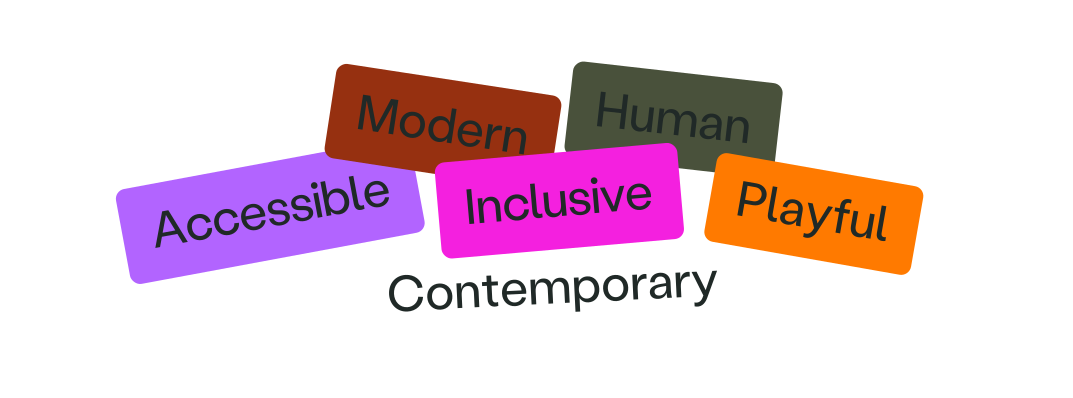
East Sussex has a strong heritage of championing creativity, and the logotype should reflect that legacy—celebrating craft, making, and the people behind it. It should feel considered and high-quality, with a clear sense of integrity and warmth, while remaining contemporary and versatile across digital applications. The overall execution must be accessible and legible, with balanced proportions and confident typographic clarity at a range of sizes.
Creativity is rooted in play, so the logotype should also carry a subtle sense of freedom and optimism in its composition. This doesn’t need to be overtly “quirky,” but it should avoid feeling overly rigid—introducing an element of lightness through pacing, rhythm, spacing, or a distinctive typographic detail that brings character. The result should communicate openness and inclusivity, with an approachable tone that feels inviting to a broad audience.
Accessible typography
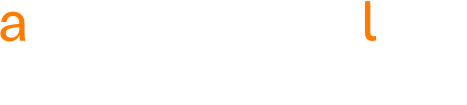
Our choice of font was important to get a balance between accessibility and character. The logotype is based on Stabil Grotesque and has a few key features that help readability.
1. The lower case “l” has a curved terminal which gives it distinction from an upper case “I”.
2. The lower case “a” used is double story, making its identification at a glance easier than that of a closed 'a'.

X-height
One other feature of the font that was important was it's x-height, which is large in comparison to the cap height. Larger X heights are a good choice for situations where clarity and readability is important.
As the logotype is set in lowercase this was also an important factor in making a visually balanced mark. See here compared to Gill Sans.